
Tift County Court Records After Arrest
After a Tift County arrest, the first public trail is usually the jail roster entry. The sheriff-linked roster can show current custody status, arrest date and time, total bond, arresting officer, warrant number, charge description, statute, counts, and court when those fields are available. That is still a jail record. The court record begins when the case moves into Magistrate, State, Superior, or Municipal Court and the charging authority files or pursues a charge.
That distinction matters. A person booked into the Tift County Jail may have an arrest charge that changes before arraignment, plea, trial, or dismissal. Felony prosecutions generally belong with the District Attorney for the Tifton Judicial Circuit and Superior Court. State Court misdemeanors are prosecuted by the Solicitor-General. Warrant, first-appearance, bond, and preliminary-hearing issues may be handled by Magistrate Court before the later case is routed elsewhere.
Use jail inmate records for the custody side of the search, including the current roster and booking-date tools. Use jail roster mugshots for the booking-photo question, because Georgia treats booking photographs differently from ordinary docket information. Court records after a jail arrest should be read as case records, not as a complete criminal-history report.
Tift County Court Search
Georgia Courts e-access routes Tift County State Court and Tift County Superior Court searches to PeachCourt. PeachCourt is account-gated. Georgia Courts says users are redirected to a provider website and must have an account to search court records. PeachCourt registration is available for attorneys and non-attorneys, and the access page uses email and password fields for sign-in.
The Georgia Courts e-access page lists the statewide route for court-record access. Georgia Courts e-access directs Tift State and Superior records users toward PeachCourt.
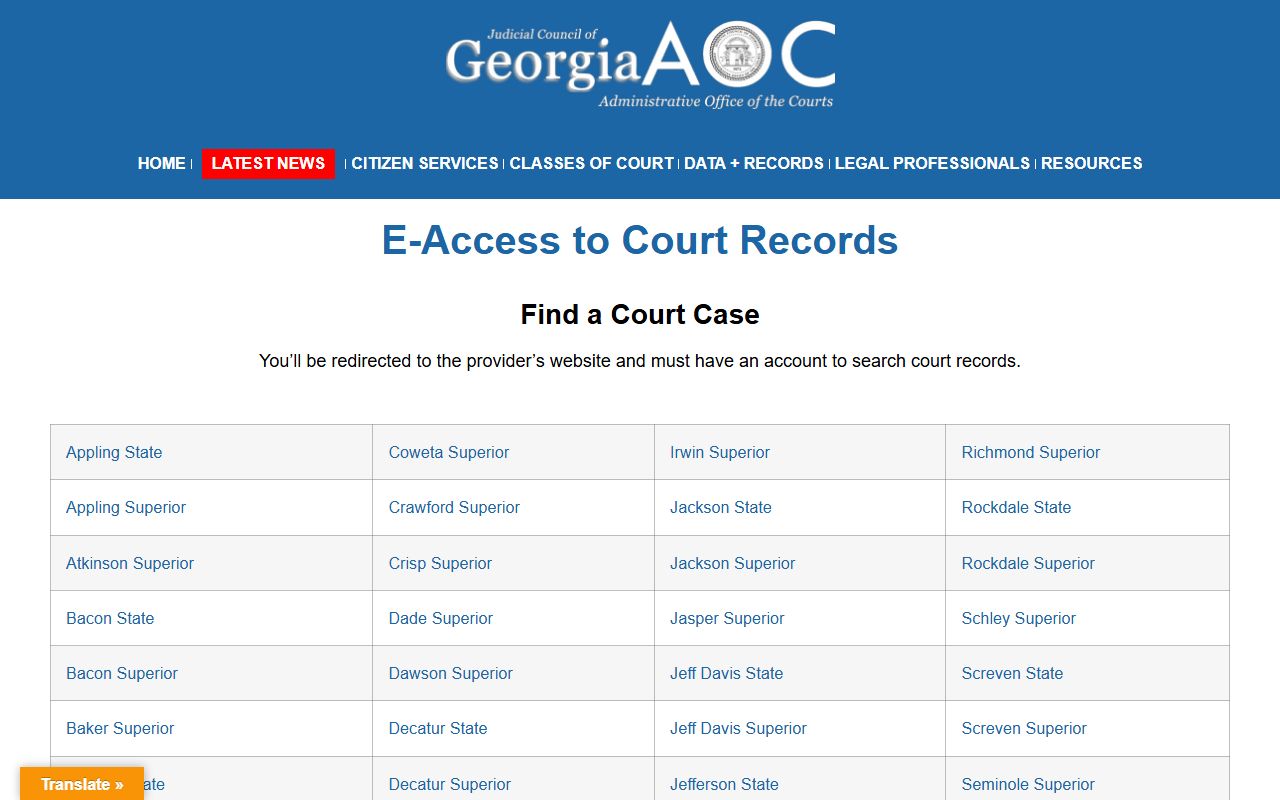
This statewide routing step is useful when the jail roster shows a court field but not the full docket history.
- Start with the Tift County jail roster if the person was recently booked, then note the name spelling, arrest date, charge wording, warrant number, and court field.
- Use PeachCourt for Tift State or Superior records after creating or signing into an account.
- Search by county and court, then use a case number or party name when those fields are available after login.
- Open the docket and read each charge separately, because one booking can produce multiple charge entries with different outcomes.
- Contact the correct local court office when the portal does not show a recent case or when a bond, warrant, or first-appearance issue is still pending.
PeachCourt documentation says criminal docket pages may show assigned judge, case status, co-defendants, prosecuting attorney, defense attorney, charges, dispositions, disposition dates, calendar events, docket proceedings, and case documents. Availability varies by court. Document access may involve purchase, page, or convenience fees, so the portal should not be treated as a free unlimited document archive.
The PeachCourt login screen is the account gate for those Tift court searches. PeachCourt access requires sign-in before case-search fields are available.

When no case appears yet, the court office may still be the better source because very recent arrests can lag behind the docketing system.
Tift County Court Offices
The Clerk of Court is the local contact point for Superior and State criminal filings. The Tift court-records source lists Clerk Clay Pate at 237 East 2nd Street, Tifton, GA 31794, mailing PO Box 354, Tifton, GA 31793, phone 229-386-7810, fax 229-386-7813, with hours of Monday through Friday, 8:00 a.m. to 5:00 p.m. The clerk page is especially relevant once a booking charge has moved from jail records into a filed criminal case.
The Tift County Clerk of Court page is a direct local source for criminal filing responsibilities. Tift County Clerk of Court publishes the office contact block and filing role.
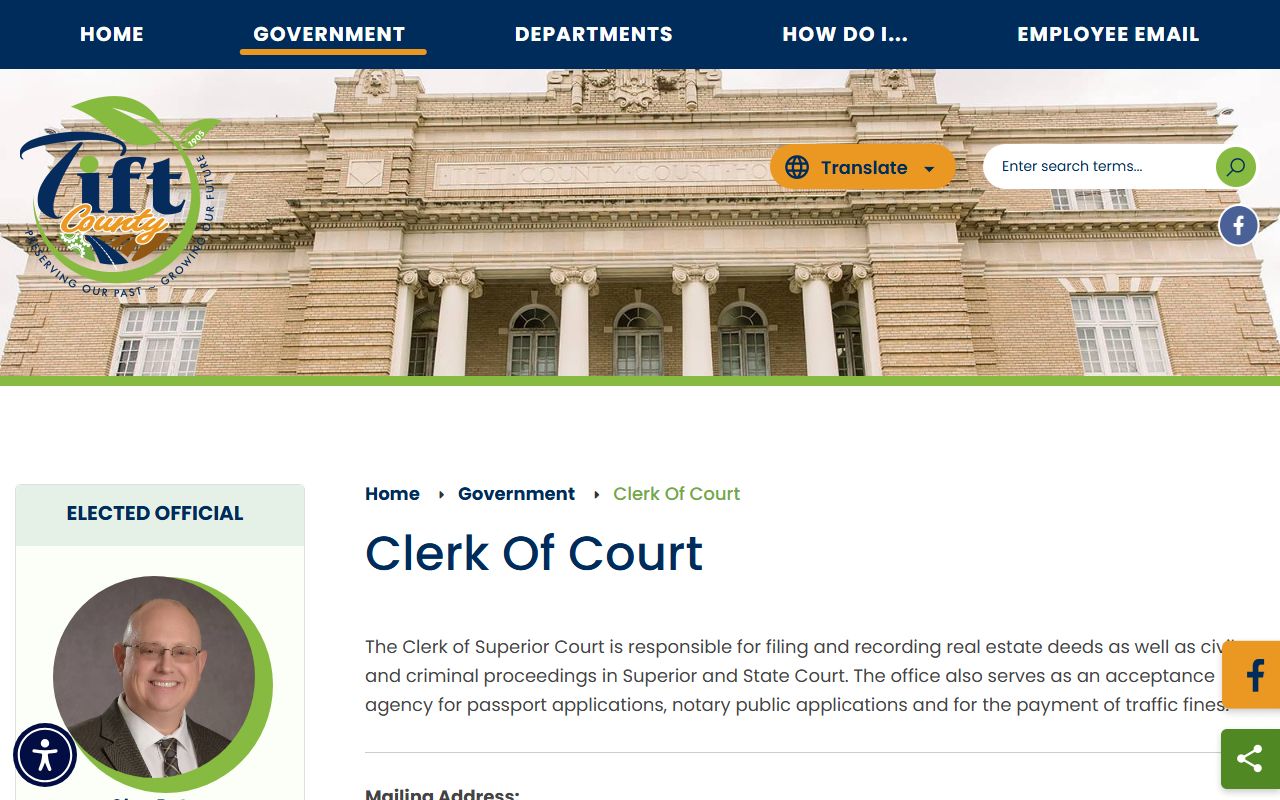
The clerk contact is most useful after a searcher has enough information to identify the court, party, case number, or approximate filing date.
Magistrate Court is central immediately after arrest. Chief Magistrate Bryan Cavenaugh's office is listed at 225 Tift Avenue, Room 211, Tifton, GA 31794, mailing PO Box 214, Tifton, GA 31793, phone 229-386-7907, fax 229-386-7978. The county Magistrate page covers criminal arrest warrants, warrant hearings, preliminary hearings, pre-arraignments, bond hearings, and county-ordinance hearings. Local first appearances are held almost daily between 2:00 p.m. and 4:00 p.m. in the Magistrate Courtroom at the Tift County Administration Building, 225 North Tift Avenue, Suite 212, Tifton, with defendants appearing by video. First appearance is not a trial. It is used to advise the arrested person of the charge and rights, ask about public-defender interest, and address bond when the law allows.
State Court handles misdemeanor criminal offenses punishable by up to 12 months in jail and $1,000, or $5,000 for aggravated misdemeanors. It also handles traffic offenses in unincorporated Tift County, municipal traffic matters when a jury demand is filed, appeals from Magistrate Court, and issuance of arrest and search warrants. Tifton Municipal Court handles city ordinance violations, traffic violations, and certain state misdemeanors in city limits. Municipal Court meets Wednesdays at 2:00 p.m. at the Criminal Justice Center, 130 East 5th Street, Tifton, GA 31794.
Tift Arrest Charging Documents
Charging paperwork is where a jail arrest starts turning into a court case. The jail roster may show the arresting agency's charge description, a statute, a warrant number, and a court field, but the court record depends on what the prosecutor or court files. Georgia terminology and local practice can vary by charge level. For Tift County users, the practical point is to compare the roster's booking language with the later docket language before assuming they match.
| Document | Common Use | What to Check |
|---|---|---|
| Complaint or warrant paperwork | Often connected to the arrest, first appearance, and lower-court routing. | Warrant number, charge wording, issuing court, bond status, and whether the case was transferred. |
| Accusation or information | Used by prosecutors to pursue many misdemeanor or non-indicted charges. | Filed charge, prosecutor, count number, statute, arraignment, disposition, and any amendment. |
| Indictment | Used for felony cases presented through the grand-jury process. | Count-by-count felony charges, Superior Court case number, DA involvement, and later plea or trial entries. |
Patrick Warren is listed by the Prosecuting Attorneys' Council as District Attorney for Tift County, with office address PO Box 1252, Tifton, Georgia 31793-1252, phone 229-386-7900. The Tifton Judicial Circuit includes Irwin, Tift, Turner, and Worth counties. For State Court misdemeanors, Solicitor-General Jason Hoffman prosecutes misdemeanor cases from 225 C Tift Avenue, Suite 3, Tifton, GA 31794, phone 229-386-7950.
Tift Court Charge Status
Court records after an arrest can change several times. A charge can be pending at first appearance, amended after review, reduced during plea negotiations, dismissed, or ended by a prosecutor's decision not to continue. The jail roster may continue to reflect booking language or custody status, while the docket may show a later, more formal charge path. Read each count on its own.
| Status | Meaning in a Tift County case |
|---|---|
| Pending | The charge or case has not reached final disposition. Upcoming court dates, bond conditions, or filings may still matter. |
| Amended | The filed charge was changed from the original wording, statute, count, level, or factual allegation. |
| Reduced | A lesser offense replaced the original charge or the person resolved the case through a lesser charge. |
| Dismissed | The charge ended by court or prosecution action and should not be described as a conviction. |
| Nolle prosequi | The prosecutor formally declined to continue prosecution on that charge. |
| Disposition | The final result for a charge or case, such as dismissal, plea, verdict, or other court action. |
Tift Arrest Bond Records
Bond information may appear in both jail and court records, but it should be verified with the jail or court before anyone sends money. The sheriff Public Information page directs questions about inmates, jail, visitation, and bonding procedures to 229-388-6020. A Tift first appearance can address bond if Georgia law allows it and if no known factor causes the judge to decline bond. If Magistrate Court does not set bond, the bond question can move to the appropriate court.
Georgia law requires special care for serious offenses. O.C.G.A. 17-6-1 lists offenses that are bailable only before a Superior Court judge, and it requires courts to consider flight risk, danger to persons or property, risk of committing a felony while awaiting trial, witness intimidation or obstruction, and financial circumstances. A local bond amount also does not erase a hold from another county, GDC, ICE, USMS, parole, or probation.
| Bond type | How it works locally |
|---|---|
| Cash bond | The full amount is deposited with the proper official or depository, with a receipt recorded under Georgia law. |
| Surety bond | A licensed surety or bonding company posts the bond when that form is allowed by the court. |
| Property bond | Property secures the bond when the court and local procedures permit that option. |
| Recognizance bond | The person is released on a promise to appear when authorized by the court. |
| No-bond or court-only hold | Release is unavailable until the proper judge or court acts. |
| Detainer or outside hold | Another agency can keep the person in custody even when a Tift bond is posted. |
Bond payment caution: The sheriff's August 5, 2025 scam alert said Tift County Pre-Probation does not exist, the Sheriff's Office does not accept Cash App, Venmo, or Bitcoin for bonds, and AllPaid is the only accepted credit-card bond service.
Tift County Warrant Records
Tift County does not appear to publish a general searchable active-warrant database. The sheriff's Most Wanted page is a public wanted-person notice page, not a complete warrant search. It includes sorting and pagination controls and carries a warning that information is provided for convenience, cannot be certified for accuracy or authenticity, and should not lead users to take independent action.
For warrant, subpoena, civil-paper, and report questions, the sheriff Public Information page lists 229-388-6021. Support Services enters warrants into the records-management system and enters wanted or missing persons into GCIC. Magistrate Court issues criminal arrest warrants and handles warrant hearings. State Court also has jurisdiction that includes issuance of arrest and search warrants, and Tifton Municipal Court can generate warrants tied to unpaid or unresolved citations.
Georgia.gov warrant guidance tells users to contact the local sheriff's office for existing warrant information in a county. Many offices may require date of birth plus first and last name, especially when a person is asking about their own status. Do not treat a missing Most Wanted entry as proof that no warrant exists.
Charges And Convictions
An arrest charge is an accusation, not a conviction. Tift County court records may show that a charge was filed, amended, reduced, or dismissed without ever becoming a conviction. A conviction requires a guilty plea, guilty verdict, or other conviction result entered by the court. This is why the disposition field matters more than the booking charge alone.
| Question | Charge | Conviction |
|---|---|---|
| Stage | Accusation after arrest or filing. | Final adjudication by plea, verdict, or qualifying court result. |
| Proof level | Based on probable cause or prosecutor filing decision. | Requires proof beyond a reasonable doubt or a valid guilty plea. |
| Public meaning | Shows the case was alleged or filed. | Shows a resolved finding of guilt or conviction outcome. |
Sealed vs. expunged language needs Georgia-specific caution. Georgia uses record restriction language rather than treating every eligible record as destroyed. O.C.G.A. 35-3-37 governs criminal history record restriction for eligible records used for non-criminal-justice purposes. The Tift sheriff Public Information page lists a $25.00 record restriction fee per arrest. Eligibility depends on the case result and the agency or court process involved.
| Question | Restricted or sealed access | Expunged in common speech |
|---|---|---|
| Georgia term | Record restriction is the safer Georgia-specific term for many criminal-history limits. | People often say expunged, but Georgia procedures do not always mean physical destruction. |
| Public visibility | Eligible records may be limited from public criminal-history dissemination. | The practical result may feel similar to removal from ordinary public searches. |
| Who may still see it | Criminal-justice agencies may retain access where law allows. | Do not assume every agency copy disappears. |
| Where to start | Use GBI record-restriction guidance and the court or arresting agency tied to the case. | Verify the exact Georgia process before relying on the term. |
Tift Court Records Access Limits
Georgia's Open Records Act starts from a broad public-records policy, but it also includes exemptions. O.C.G.A. 50-18-70 defines public records and states the open-government policy. O.C.G.A. 50-18-71 governs timing, inspection, copying, and fees. O.C.G.A. 50-18-72 lists exemptions, including some law-enforcement and prosecution records. O.C.G.A. 42-4-7 requires sheriffs to keep a record of persons committed to county jail and makes that record subject to Open Records Act examination.
The Tift County Sheriff's Office accepts open-record requests verbally or in writing and says requests will be handled under O.C.G.A. 50-18-70. David Haire is the Open Records Officer, and Captain Chad Davis is the alternate. Requesters are responsible for fees associated with filling a request, and an estimated preparation cost will be provided. For criminal-history reports, the sheriff page lists a $5.00 fee, a signed consent form, two forms of identification with one photo ID, and up to 48 hours for completion.
Use limit: Tift County Inmate Population is not a consumer reporting agency under the Fair Credit Reporting Act. Do not use jail, court, or arrest information from these pages for employment, credit, housing, insurance, or another FCRA-covered decision.